
Planned Garage Door Spring Replacement in Milwaukee, WI
Cycle math before you choose standard or high-cycle.
Replace on your schedule, not the spring's. Cycle estimate calculated on-site, standard vs. high-cycle options written down, your decision before the first bolt turns. No emergency rate for pre-planned work.


Four times a day. 365 days a year. 1,460 cycles per year.
Standard spring rated at 10,000 cycles. That's six years and ten months — not the decade most homeowners assume.
SE Wisconsin homeowners often stay in their homes for ten to fifteen years without touching the original springs. The door still opens. The spring hasn't snapped yet. But the rated cycle life passed years ago.
If a spring already broke this morning, see snapped torsion spring repair. If you're unsure whether your spring needs repair or full replacement, spring repair walks through that diagnostic.
This page is for homeowners who want to get ahead of the failure — choose their spring type, schedule during regular hours, and avoid the premium that comes with a 2AM emergency call.
Four Standards That Hold on Every Spring Replacement
No skipped steps. The standards below apply whether you choose standard 10K-cycle springs or upgrade to high-cycle — the install process is the same; only the spring rating changes.

Matched Pairs Always
Both springs replaced together. One spring aging faster than the other pulls the door unevenly and loads the opener asymmetrically. Matched pairs are a fixed install standard on every DiamondLift replacement — not an upsell.

Wire Gauge Confirmed
Confirmed against door weight before installation. Mismatched gauge creates balance problems that shorten opener motor life — a spring underpowered for the door weight forces the opener to compensate on every cycle.
Torsion Shaft Inspected
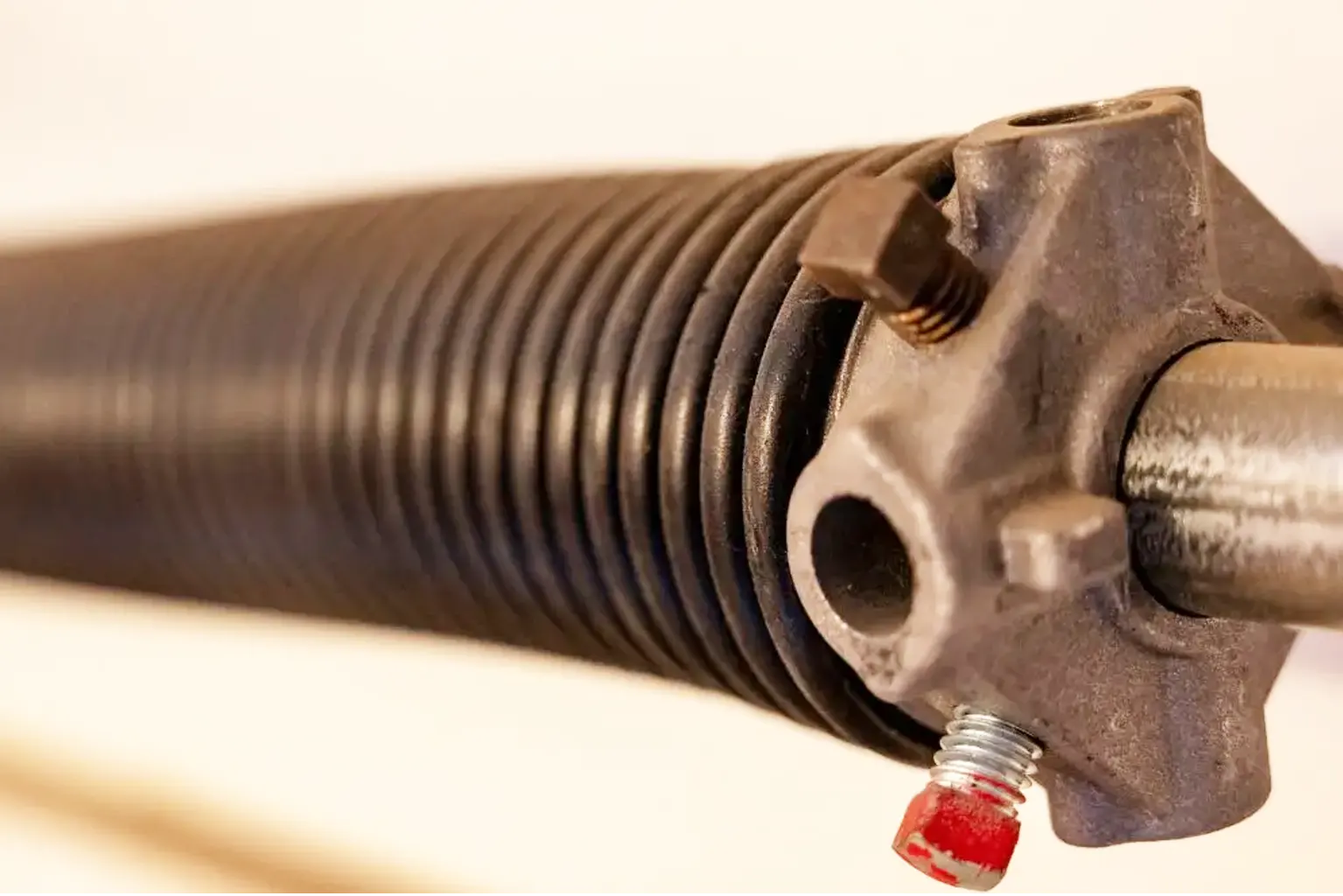
Checked for wear before new springs are wound. A damaged shaft compromises the new installation from the first cycle — new springs on a worn shaft will track unevenly and wear faster than rated.

Safety Cables Confirmed
On extension spring systems, presence and condition of safety cables confirmed regardless of the primary call reason. Steel cables through the center of the spring keep a broken spring from becoming a projectile inside the garage.

"The first thing I do on a spring replacement call isn't look at the spring. It's ask one question."
How many times a day does this door open?
Most homeowners say two or three. Then we count through the day together. Morning when the car leaves. Midday lunch. After school. Evening. A quick trip to the garage for a tool. A lot of households land at five or six cycles daily without ever thinking about it that way. A household running six cycles a day hits 10,000 in under five years.
I do the math right there on paper. Daily estimate. Multiply by 365. Divide 10,000 by that number. Thirty seconds. When I turn the paper around, the conversation shifts. Instead of "my spring broke, replace it," it becomes "my spring was already three years past its rated life — what's the smarter choice this time?"
That's where the high-cycle upgrade enters the conversation. For a household running five cycles a day, a 25,000-cycle spring lasts roughly fourteen years between replacements instead of five. The math on avoiding one emergency replacement call typically covers the upgrade cost within two to three years.
Both options written down before the first bolt turns
No spring type recommended without showing the math first. You see your specific cycle estimate, the cost difference between options, and the projected replacement interval.
For a Milwaukee household averaging four cycles per day:
- Standard residential — 10,000 cycles — ~6.8 years (industry baseline)
- High-cycle upgrade — 25,000 cycles — ~17 years (heavier-gauge wire)
- Premium high-cycle — 50,000 cycles — ~34 years (highest-use households)
For households in Brookfield, Waukesha, and Oconomowoc running attached garages with daily use above four cycles, the high-cycle upgrade typically pays for itself before the standard spring would have reached its next replacement date.

Cycle Math, Install, Five-Cycle Verify
Manual disconnect and balance check first. Cycle math on paper before any installation begins. Tension set with a calibrated gauge — not approximated by feel. Five full cycles before sign-off.

Cycle Assessment & Options
Manual disconnect, balance check, then cycle math on paper. Daily use estimate, annual cycle projection, current spring age measured against rated life. Both options — standard and high-cycle — written down and presented before installation begins.
Installation
Springs installed in matched pairs to the correct gauge and cycle spec for the door's weight and track geometry. Safety cable integrity confirmed. Torsion shaft checked before winding. Tension set with a calibrated gauge, not approximated by feel.
Five-Cycle Verification
Door reconnected and run through five full cycles. Balance test repeated with the opener connected to confirm motor load is within normal operating range. Written cycle estimate and spring specification left with the homeowner for reference at the next service visit.
Pair the visit with a tune-up — one window, fewer return calls.
Address rollers, cables, hinges, and opener load while the door is already disconnected. One visit, one service window, no separate call when the next component needs attention.
Three Spring Tiers, Three Different Service Lives
Same install process across all three. Only the cycle rating changes. Projected service life below assumes a household averaging four open-close cycles per day.
Standard Residential — 10,000 Cycles
Industry baseline. Roughly 6.8 years at four daily cycles. Lower upfront cost. Right fit for households with low usage, infrequent garage access, or a planning horizon under seven years. Same matched-pair install standard as the upgrades.
High-Cycle Upgrade — 25,000 Cycles
Roughly 17 years at four daily cycles. Wound from heavier-gauge steel wire. For most Milwaukee households running four or more daily cycles, the upfront cost difference is typically recovered before a standard spring would have needed its next replacement.
Premium High-Cycle — 50,000 Cycles
Roughly 34 years at four daily cycles — or the equivalent of higher daily use over a shorter horizon. Right fit for highest-use households, multi-generation homes with heavy garage access, or homeowners who simply don't want to think about spring replacement again.
Spring Replacement Questions from Milwaukee Homeowners
Planned replacement is scheduled in advance based on cycle count or inspection findings — before any failure occurs. Emergency and snap repair calls happen after a spring breaks, typically at an unplanned hour and at a higher cost. This page covers proactive replacement only.
Most planned spring replacement visits take 60 to 90 minutes. That includes the cycle math calculation, spring options review, installation, and a five-cycle post-test. Pairing the visit with a tune-up adds time but eliminates a separate service call later.
Cycle math is calculated on-site for your household’s specific daily use before any installation begins. Both standard and high-cycle options are written down and presented. No spring type is recommended without showing the numbers first. That process is what separates a planned replacement from a parts-swap.
Yes, for most households running four or more cycles per day. A standard 10,000-cycle spring lasts roughly seven years at four daily cycles. A 25,000-cycle spring lasts roughly seventeen years at the same use rate. The upfront cost difference is typically recovered before the standard spring would have needed its next replacement.
Springs past their rated cycle life are operating outside their tested performance range. Failure doesn’t happen at an exact cycle count, but the risk increases with every cycle past 10,000. Planned replacement during regular hours costs less and gives you spring-type options. Waiting until a snap event means an emergency call with no time to compare.
Both springs are replaced as a matched pair. Installing a new spring alongside an older one creates an imbalance — the worn spring pulls the door unevenly and overloads the opener on one side. Matched pairs are a fixed install standard on every DiamondLift spring replacement, not an upsell.
Planned Replacements Across the Milwaukee Metro
West to Waukesha and Oconomowoc, north to Menomonee Falls and Brown Deer, through inner-ring suburbs of West Allis, New Berlin, and Brookfield. Pre-war neighborhoods in Milwaukee proper — Bay View, Riverwest, near west side — often have original spring hardware where cycle math is especially relevant.
Cycle math done before the first bolt turns.
Planned replacement costs less than emergency replacement — and puts the spring-type choice back in your hands. Both spring options ready on arrival.
(414) 296-9783